
Field of interest
The research team is composed of staff members from the Chair of Analytical Chemistry at the Faculty of Chemistry, WUT. The scientific interests of the team members focus on a wide range of topics in modern analytical chemistry, including: speciation analysis of metals in environmental, plant, food, and biological/physiological samples using mass spectrometry and hyphenated techniques; identification and quantification of chemical compounds using molecular mass spectrometry; investigation of the bioavailability of micro- and macroelements; research in metallomics and proteomics; development of novel extraction methods; bioanalytical chemistry of active compounds and nanomaterials; simulation of the metabolic transformations of metallodrugs using electrochemical techniques.
Keywords
# trace analysis #speciation analysis #food/environmental /drugs analysis #mass spectrometry #separation techniques #nanomaterials #hyphenated techniques
Offered research services
- Quantitative and qualitative determination of elemental or isotopic composition in complex samples using ICP-MS/MS,
- Determination of average size, dispersion, and particle number per mL of spherical nanoparticles with defined composition larger than 10 nm using ICP-MS/MS in single particle analysis mode,
- Quantitative and qualitative speciation analysis of metals and metalloids, including the determination of analyte‒protein and analyte‒DNA complexes, using hyphenated techniques,
- Detection and structural elucidation of small molecules (e.g., metabolites, reaction products) in liquid samples using ESI-MS/MS,
- Identification of proteins in liquid matrices using bottom-up or shotgun proteomics approaches,
- Simulation of the transportation and metabolism of nanomaterials and active compounds in human, animal, or plant systems, as well as in cell cultures, tissues, and fluids,
- Simulation of gastric and intestinal digestion processes for studying compound stability and bioavailability,
- Quantitative and qualitative analysis of inorganic cations and anions using ion chromatography (IC) with conductivity detection.
Research Infrastructure
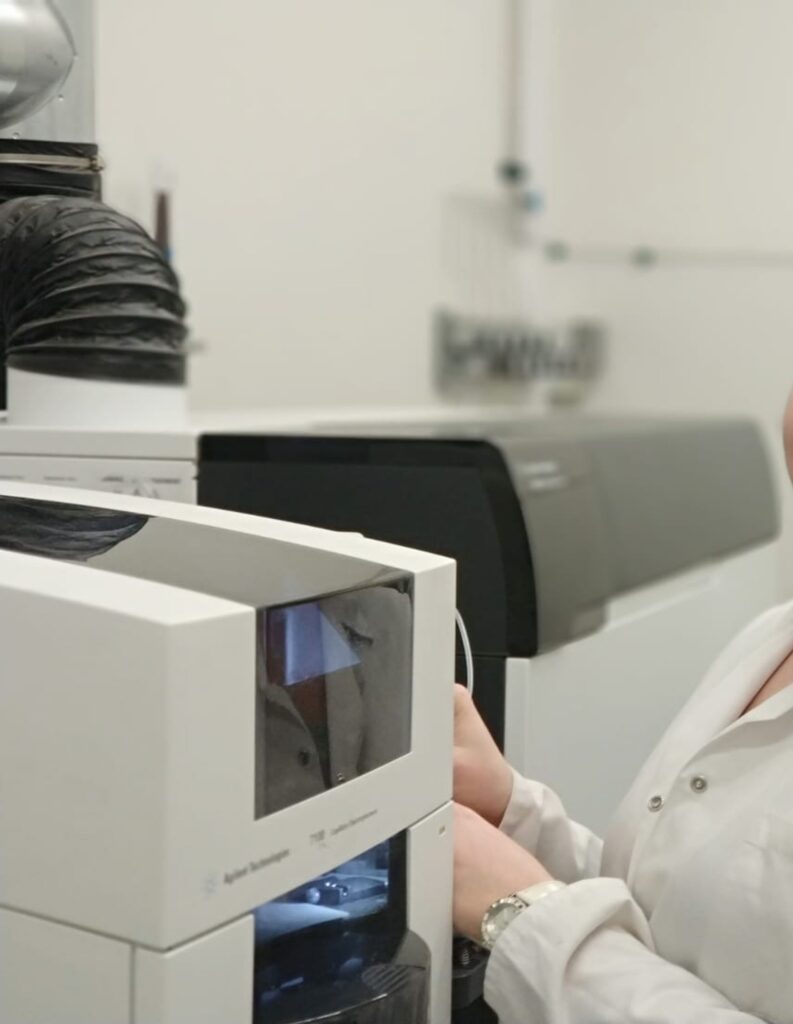
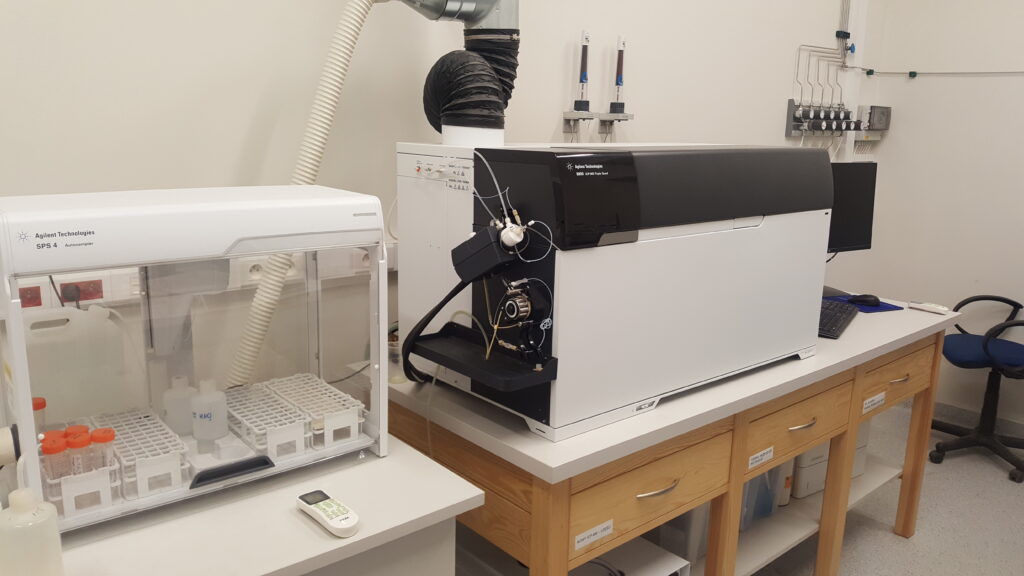
- Inductively Coupled Plasma Mass Spectrometry (ICP-MS/MS) with Single Particle and Single Cell analysis modules –unique setups at the national level, enabling the analysis of individual nanoobjects,
- Capillary Electrophoresis (CE) coupled to ICP-MS/MS – a unique system in Poland, allowing the high-resolution advanced elemental speciation analysis,
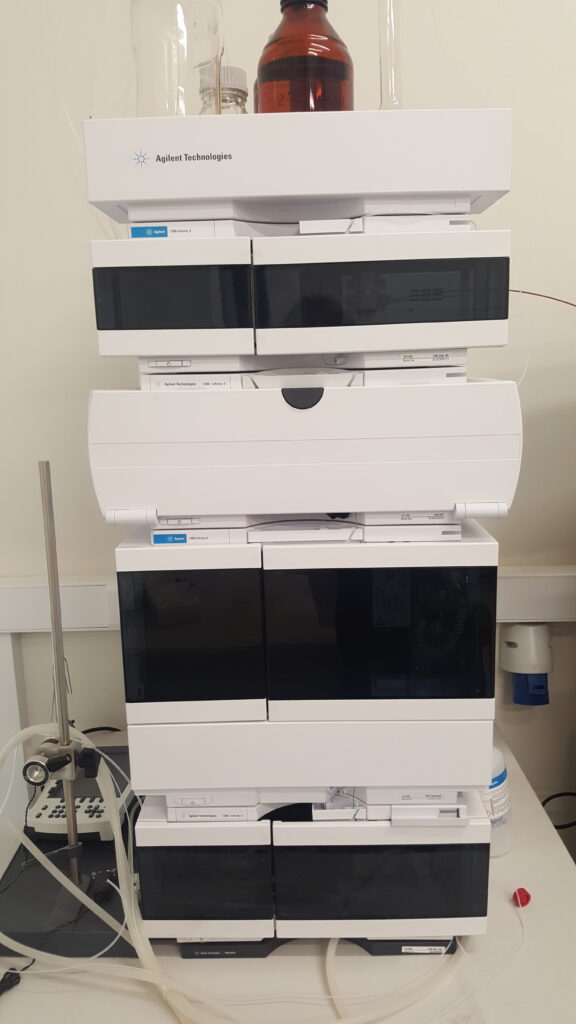
- High-Performance Liquid Chromatography (HPLC) with automated sample injection coupled to ICP-MS/MS – for comprehensive separation and detection of elemental species,
- CE or HPLC (classical or microflow systems with automated sample injection) hyphenated to Electrospray Ionization Tandem Mass Spectrometry (ESI-MS/MS) – for molecular-level identification and quantification of complex analytes.
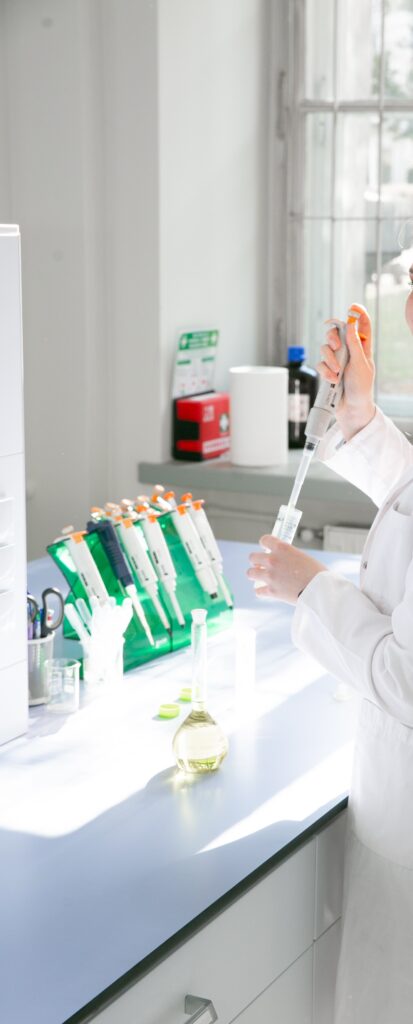
- Our facilities are equipped with state-of-the-art instruments dedicated to advanced sample preparation, enabling high-precision, contamination-free processing of a wide range of sample matrices for trace and speciation analysis.
Invention, patents, patent applications
- Patent applications no. P.449645 and P.449647 (August 2024) concerning the liposomal compositions containing GHK-Cu, methods of their preparation, and use
Selected Projects
- Analytical platform based on tandem elemental mass spectrometry for simulating and studying the in vitro changes of systems comprising liposomes and pharmaceutically and cosmetically active compounds (IDUB, Lab-Tech of Excellence 1, 2022-2025)
- Tandem mass spectrometry as a bioanalytical platform for characterization of medicinally promising superparamegnetic nanoparticles (NCN OPUS, 2019-2023)
- Analytical methodology for investigation of the cellular speciation of theranostic metal-based nanomaterials: development, optimization, and in vitro application (NCN OPUS, 2016-2020)
- Analytical methodology for the investigation of ZnO and TiO2 nanoparticles metabolism in edible plants – lettuce and radish (NCN Harmonia, 2016-2020)
- Development and certification of new reference materials necessary for European accreditation of Polish laboratories specializing in industrial analytics (INNOTECH NCBiR, 2012-2015)